

Top End
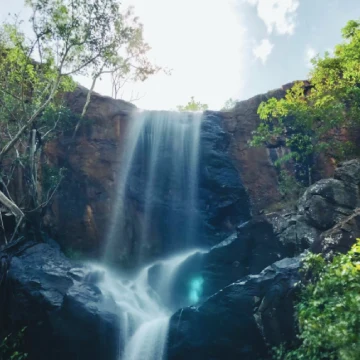
The Top End region encompasses the Tiwi Islands, Daly and West Arnhem, extending from Wadeye in the west to Maningrida in the east. Around 18,700 people live in the Top End region with major population centres in Wadeye and Jabiru. The region’s population is relatively young, with around 36% aged 24 years and under, and only about 9% aged 65 years or older.
Major industries in the region include tourism, horticulture and forestry. Tourism is a significant contributor to economic activity in the Top End, with world-renowned attractions, such as Litchfield and Kakadu national parks, as well as the Daly River for recreational fishing and camping.
Kakadu internet connection
Works have been completed at Kakadu National Park, equipping more locations with internet access, as part of a partnership with the Territory, Commonwealth and Telstra.
As part of the $7.5 million deal, three major cell towers at Jim Jim ranger station, Cooinda Lodge and Arnhem Highway have improved mobile coverage, supporting real-time connectivity. Smaller cell sites include Gungurul, Mary River ranger station, the northern information bay on the Arnhem Highway, Nourlangie rock art site, Yurmikmik, and Gunlom Falls, Karnamarr and Maguk campgrounds.
Remote housing
The Territory Government is continuing to reduce overcrowding and improve housing quality across communities in the Top End.
Co-funded by the Territory and Commonwealth, the investments are delivered under the 10-year remote housing agreement. To date, 91 new homes have been delivered and a further 37 dwellings have had comprehensive repairs and upgrades.
In 2026-27, it is expected that a further 66 new dwellings will be constructed, 12 homes will be refurbished, and 47 new lots made available across communities in the Top End.
Parks and reserves
The Territory Government has secured an additional 30,000 hectares through the purchase of the Silkwood Estate, expanding our iconic Litchfield National Park.
Bringing Silkwood into public ownership has protected this remarkable landscape for current and future generations, while further strengthening the Territory’s reputation as one of Australia’s premier outdoor destinations.
Longer-term planning for Silkwood, informed by stakeholder feedback, will also identify sustainable tourism and commercial opportunities that create regional jobs, support local businesses and grow the economy, while preserving the environmental and cultural values that make Silkwood so special.
The 2026 Budget continues to back our Parks and includes a $10 million infrastructure investment for upgraded visitor access and safety works to ensure parks such as Silkwood are safe, welcoming and well managed.
In addition, an operational funding boost of $5 million per year ongoing has been provided to the parks and wildlife division to safely and sustainably maintain parks and reserves within the Territory, including the new Silkwood estate.
Land release
The Territory Government maintains a pipeline of residential land release to ensure there is sufficient land supply for the future, as well as provide certainty to industry and community.
In 2026-27, stage 2A of the Humpty Doo industrial subdivision is anticipated to deliver nine titled lots, while stage 2 on College Road in Berrimah is scheduled to deliver 25 titled lots.
Roads
The Territory Government is continuing to boost accessibility across the Top End by improving connectivity between major parks, remote communities, enhancing flood immunity and economic productivity.
The $204 million investment in road infrastructure includes:
- $90 million to upgrade Port Keats Road connecting Wadeye and Palumpa
- $63 million to upgrade Jabiru Road within Kakadu National Park
- $41 million to upgrade roads on the Tiwi Islands.
The 2026 Budget includes an additional $4 million on selected upgrades on the Cox Peninsula Road Pavement Rehabilitation under a $60 million Road Asset Modernisation Program investment.
Mandorah marine facilities
Construction of the new $85 million Mandorah marine facility is complete, delivering safer, more accessible marine infrastructure for residents and visitors of Mandorah, Wagit Beach and Belyuen.
St John Ambulance
The 2026 Budget provides $68 million for St John Ambulance services in 2026-27, including an ongoing $10 million per year funding boost in response to increasing demand for services.
The additional funding will improve response times, enabling faster clinical intervention and better patient outcomes, enhance community confidence and reduce pressure on existing crews.
Aeromedical services
The Territory Government is committed to delivering safe and accessible healthcare across the Territory to those who are seriously ill and injured requiring urgent medical care.
The 2026 Budget provides an additional $10 million per year ongoing funding boost from 2026-27 to continue the Top End Aeromedical Retrieval Service.
The Territory Government is also continuing to advocate strongly for the Commonwealth to appropriately fund aeromedical retrieval services in the Top End to ensure Territorians are not disadvantaged by their postcode.
Flood recovery
The Territory Government introduced the $100 million Flood Recovery Fund resilience initiative and a further $30.5 million on the Roads Repair Package to rebuild critical road infrastructure that is vital to connecting remote communities and regional economies to support industries that keep the Territory moving.
The Roads Repair Package encompasses $8 million for Top End roads, including:
- Cox Peninsula Road repairs
- Daly River Road
- Wooliana Road
- Port Keats Road.
Additionally, an immediate $12.5 million commitment to boost the first phase of the broader Flood Recovery Fund includes $0.5 million for the development of a future plan to relocate the remote town of Daly River and Nauiyu to higher ground during extreme weather events. The plan will involve engagement with the community, with the ultimate goal of ensuring the remote town is better protected and prepared in the long term.
Printable fact sheet
Get a printable copy of the Top End region fact sheet PDF (569.2 KB).